Topological Hochschild Homology with a “Twist”
Abstract
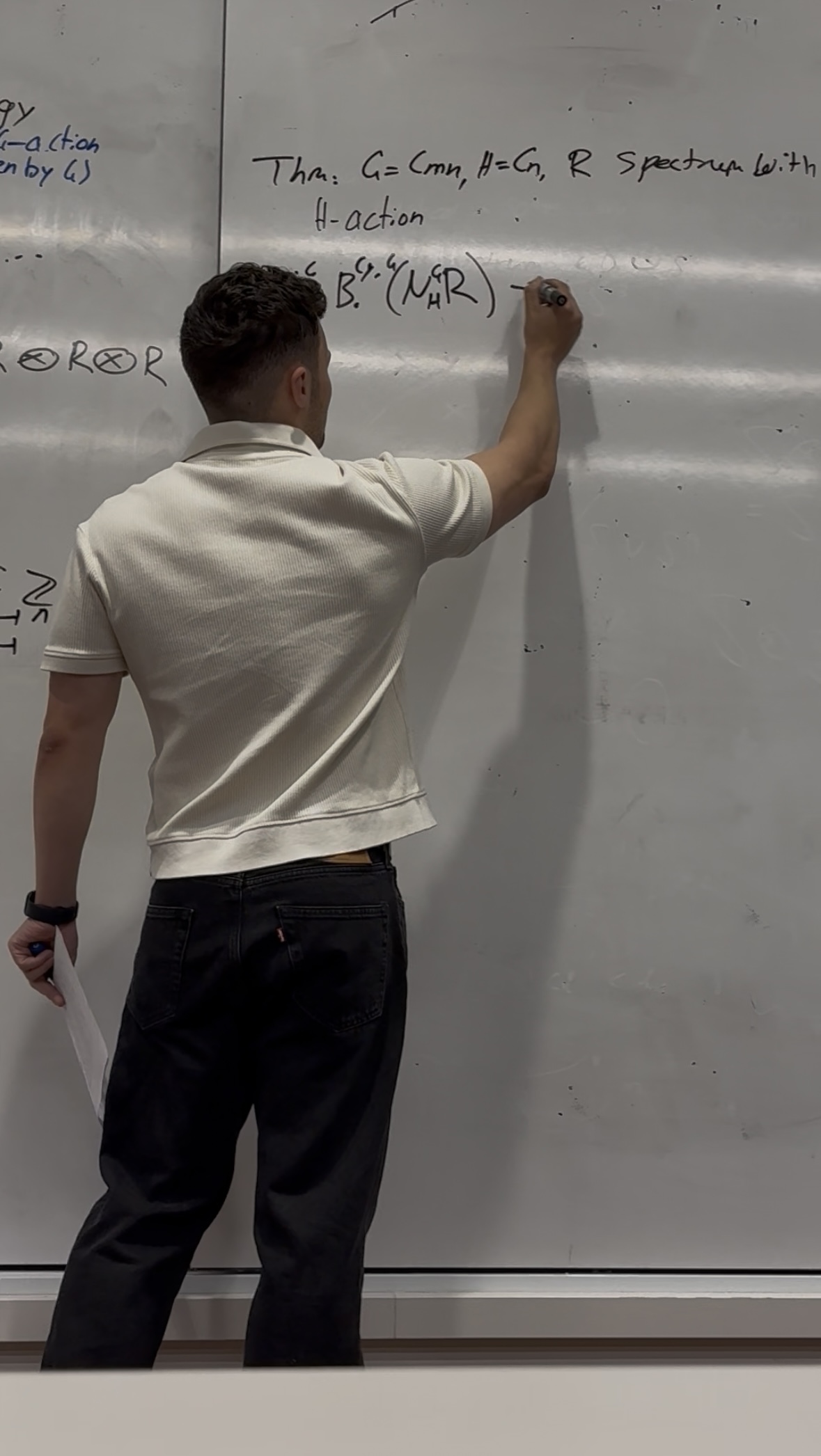
We introduce a topological version of Hochschild homology for rings, which turns out to be a "stronger" invariant in some sense. We then extend this to a “twisted” version that takes inputs with a G-action.
What is... G-stuff?
Abstract
Why did we study group theory in Algebra 1? It turns out that many objects admit a group action, and studying these actions can give us more information about the objects. We will explore G-sets, G-spaces and other G-“stuff” through some definitions and lots of examples. Strong understanding of Algebra 1 and Analysis 1 content is required.
Odd Primary Hopf Invariant One
Abstract
We give a consolidated exposition of the Hopf invariant one problem. At the prime 2 we mention Adams' secondary operation argument, showing that a map \( f \colon S^{2n-1}\to S^n\) with Hopf invariant \(\pm 1\) exists only for \( n=1,2,4,8\). For an odd prime \( p\) we follow the Adams-Atiyah translation into \(K\)-theory and prove that the mod-\( p \) Hopf invariant vanishes as soon as \( n>1 \). The unique surviving cases \( n=1 \) is realised by an explicit map \( S^{2p}\to S^3 \) that we construct in detail.
The Scariest Maths Topic (in 8 minutes)
Abstract
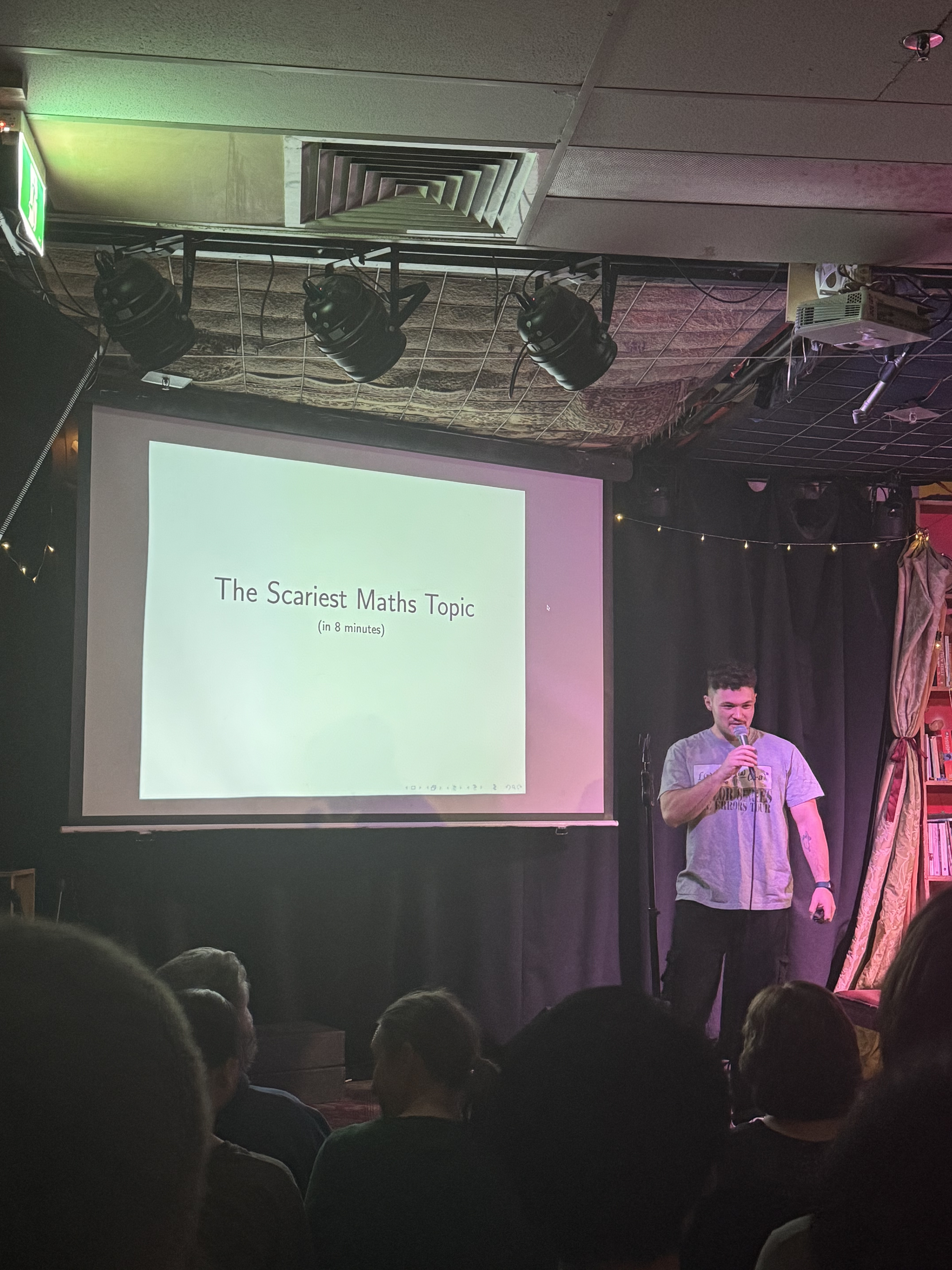
I will teach everyone in the pub the scariest maths topic (in only 8 minutes). To do this, we will learn the "Spectral Sequence Game".
Levy Integration
Abstract
We begin by introducing Poisson integration, as well as several related constructions needed to define the Levy integral. We review the Levy-Ito decomposition and show that it further decomposes into a Brownian, a compound Poisson process and a compensated Poisson process. We conclude with the construction of Levy-type stochastic integrals and an application of it to options pricing.
\( C_2 \)-Equivariance and KR-Theory
Abstract
In this work we explain the methods of Hill, Hopkins, and Ravenel in their solution of the Kervaire Invariant One problem. We make the simplification from \(C_8\) to \(C_2 \)-equivariance, describe the computational techniques involved, and talk about what these findings mean. In particular, we use the methods to compute the homotopy groups of \(KR\)-theory.